
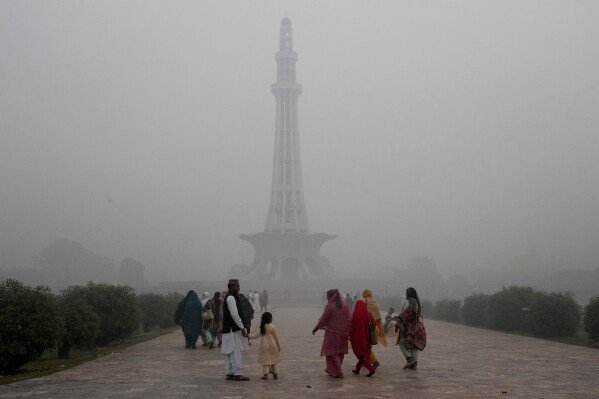
Hazardous smog grips Lahore as air quality worsens, rain unlikely
LAHORE: Air pollution in Punjab has reached critical levels this week, with Lahore ranking among the world’s most polluted cities, according to real-time data released by IQAir. The situation is expected to persist in the coming days, as no rainfall is forecast to provide relief.
On Saturday evening at around 8pm, Lahore’s Air Quality Index (AQI) surged to 527, placing it in the “hazardous” category and second only to Delhi, which recorded an AQI of 710.
The city’s three-day average AQI remained above 300, while several localities reported extremely dangerous pollution levels. Allama Iqbal Town topped the list with an AQI of 802, followed by Bedian Road at 674 and the CERP Office area at 672.
The smog crisis is not limited to Lahore alone. Multiple cities across Punjab recorded alarmingly high AQI readings between December 11 and 13, triggering widespread health alerts. Khurrianwala reported an AQI of 558, Faisalabad 547, Kahna Nau 350, Gujranwala 284, Gujrat 254, Islamabad 246, while Bahawalpur and Sialkot each recorded 244.
Medical experts have cautioned that prolonged exposure to elevated levels of PM2.5 — fine particulate matter that penetrates deep into the lungs — poses severe health risks, particularly for children, older adults and individuals with pre-existing respiratory conditions.
Authorities have advised residents to limit outdoor activities, keep windows shut, wear protective face masks and use air purifiers indoors where possible.
Pakistan’s average PM2.5 concentration in 2024 stood at 73.7 micrograms per cubic metre, nearly 15 times higher than the World Health Organisation’s recommended annual limit of 5µg/m³. As a result, Pakistan ranks as the world’s third most polluted country, highlighting the gravity of the environmental crisis.
Experts attribute the worsening air quality to a mix of industrial emissions, vehicular pollution, crop residue burning, biomass and waste incineration, and domestic fuel use. Winter weather conditions — including temperature inversions, low wind speeds and minimal rainfall — further trap pollutants near ground level.
The problem is exacerbated by transboundary pollution from India, particularly during the post-harvest stubble burning season, experts added.