World Bank GWSP Issues 2025 Annual Report on Global Water Progress
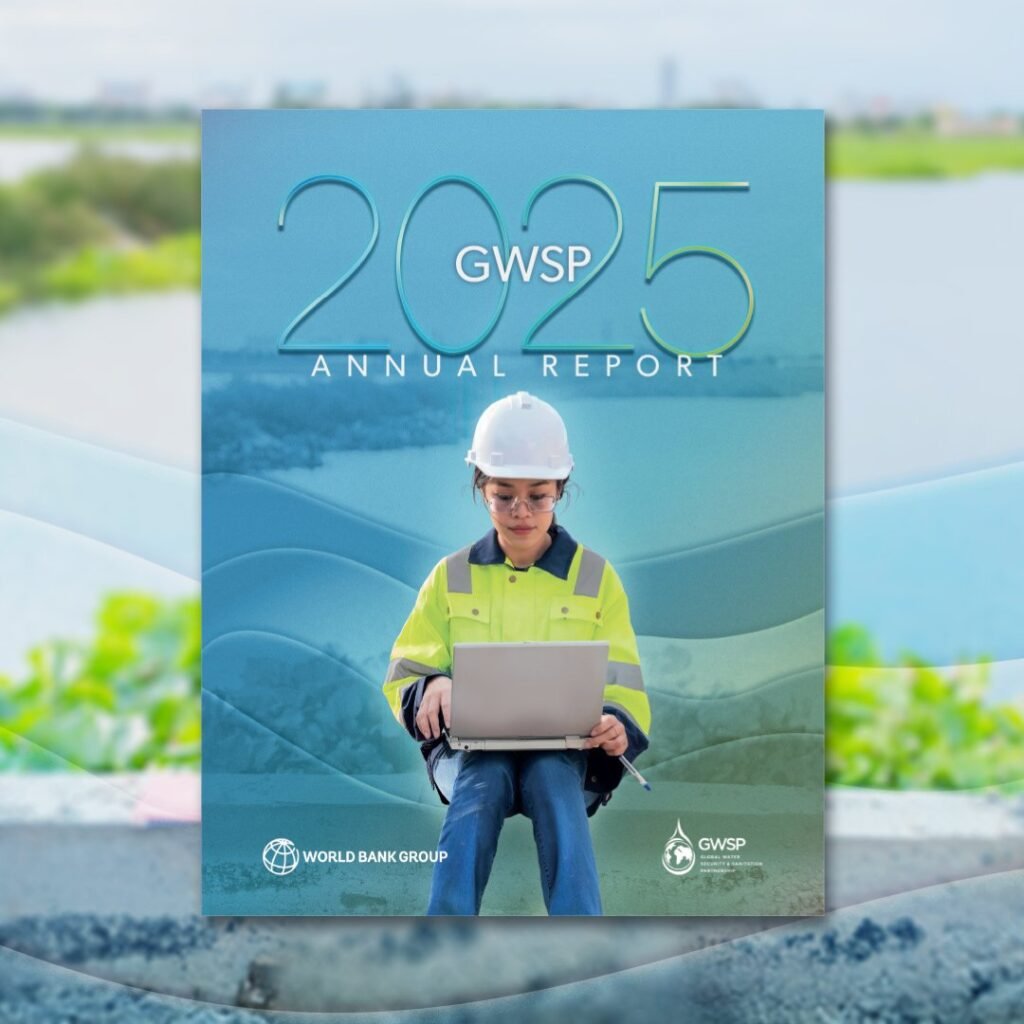
World Bank’s Global Water Security and Sanitation Partnership (GWSP) has issued its 2025 annual report, warning that while water remains central to jobs, growth and poverty reduction, the world is still facing an escalating water crisis and a serious financing gap in meeting Sustainable Development Goals. The report notes that the World Bank is now the largest multilateral investor in the water sector in developing countries, with an active portfolio of more than 29 billion dollars, and that in FY2025 its projects delivered basic water, sanitation and hygiene (WASH) services to 75.5 million people and safely managed services to 7.4 million people, up from 66.7 million and 3 million respectively in the previous year. According to GWSP, recent Bank operations have also helped 25.8 million people protect themselves against water-related risks such as floods and droughts between FY2023 and FY2025, while 7.8 million farmers adopted improved agricultural technology over the same period, underscoring the role of water in food security and rural livelihoods.
The report underlines that global investment in water-related infrastructure needs to reach an estimated 6.7 trillion dollars by 2030 and 22.6 trillion dollars by 2050, and argues that this scale cannot be met without a significant increase in private capital alongside public and concessional finance. In FY2025, GWSP-backed work on mobilizing private investment led to six water sector projects that attracted 721 million dollars in private co-financing, with 89 percent of new water projects enabling private financing and a record 56 percent having an explicit focus on mobilizing private funds, which the partnership describes as an “encouraging but still insufficient” start. The World Bank’s new Water Strategy 2025–2030, which the report presents as a central framework, seeks to increase water security and sanitation for hundreds of millions of people by scaling proven solutions and integrating the efforts of the World Bank, IFC and MIGA to improve water for people, water for food and water for the planet.
GWSP positions itself in the document as a “center of excellence” for implementing this strategy, citing its role in preparing diagnostics, designing programs and providing technical expertise that feed into a larger and faster lending pipeline and improve project quality. In 2025, the partnership’s knowledge and analytics supported 30 countries on resilience-related work, including water security diagnostics in drought-prone Somalia and a private capital mobilization plan for utilities in Gujarat, India, while its technical assistance helped 51 countries strengthen water institutions and systems. Overall, GWSP-supported activities informed 12.46 billion dollars in new World Bank lending in FY2025, bringing cumulative influenced lending to 47.89 billion dollars, with notable engagement in fragile and conflict-affected settings such as Burundi, Chad, the Democratic Republic of Congo, Somalia, South Sudan, Syria and Yemen.
The report also highlights a strong climate lens, noting that 81 percent of the Bank’s FY2025 water sector lending was counted as climate finance, the highest share yet, with resilience integrated into all new water projects and specific support to drought risk tools and resilience assessments. On social inclusion, GWSP states that 74 percent of newly approved water projects incorporated interventions going beyond basic gender and citizen engagement, while 22 out of 23 new water projects linked gender gaps to concrete actions and indicators and 62 percent of new WASH projects included disability-inclusive activities, meeting or surpassing several results framework targets ahead of FY2030. The partnership illustrates these trends with projects that train women entrepreneurs and improve menstrual health and hygiene in countries such as Bangladesh, Tanzania, Ethiopia and the Democratic Republic of Congo, and with governance tools that embed citizen feedback and the participation of women, persons with disabilities and other excluded groups in water management structures.
Looking ahead, the GWSP report combines a warning and a cautiously optimistic tone: it stresses that water systems are under mounting pressure from climate change, population growth and environmental degradation, but argues that the gains made in FY2025 demonstrate that a mix of scaled public funding, private capital, stronger institutions and knowledge-driven reforms can move countries closer to water security at scale. The document calls for deeper collaboration with governments, multilateral development banks, philanthropies, civil society and the private sector, and points to new tools such as the Water Sector Assessment Program, climate and economic analysis models, and global water data platforms as ways to guide reform and investment decisions more effectively. By documenting results and lessons across regions—from São Paulo’s water crisis response and cholera prevention work, to drought management in Afghanistan and net-zero wastewater initiatives on the Ganga—the report seeks to position GWSP as both a technical hub and a convening platform for turning global concern over water scarcity into concrete policy shifts and investment pipelines