Pakistan Urged to Adopt Integrated Approach to Address Growing Water Challenges
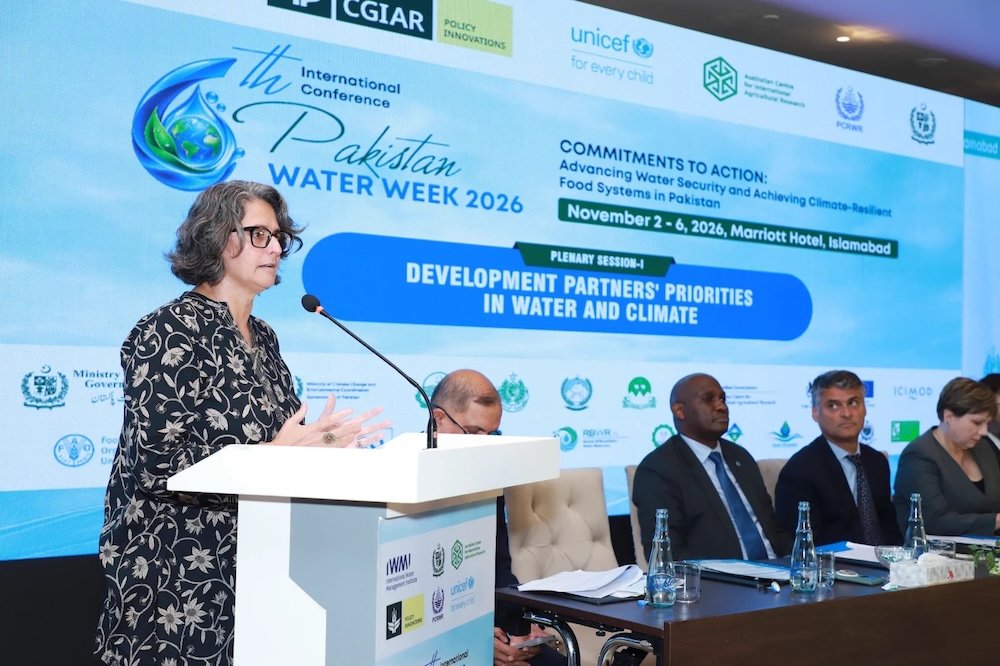
ISLAMABAD: Director of Agrifood Innovation and Resilience at the International Food Policy Research Institute (IFPRI), Dr Claudia Ringler, has called for a whole-of-government approach to address Pakistan’s growing water challenges, stressing the need for coordinated investment, climate resilience, youth engagement and stronger water governance.
Addressing the closing session of the five-day Sixth Pakistan Water Week 2026 international conference on Thursday, she said water challenges could not be addressed by water management agencies alone and required collective action across government institutions and sectors.
Reviewing the conference discussions, Dr Ringler highlighted the need for stronger regional cooperation among Himalayan countries to understand and address growing risks associated with glacial instability, rockfalls and other climate-induced hazards.
Referring to discussions on water, sanitation and hygiene (WASH), she stressed that Pakistan needed to accelerate progress towards Sustainable Development Goals 6.1 and 6.2, which relate to safe drinking water and sanitation. She called for better alignment of federal and provincial WASH plans and improved coordination among relevant institutions to achieve the 2030 targets.
Highlighting the importance of data-driven technologies, she said integrated water modelling could help balance the competing demands of cities, agriculture, energy and ecosystems while identifying trade-offs and developing mutually beneficial solutions.
On water infrastructure, she emphasised the need for comprehensive evaluation frameworks covering agricultural, financial, economic, environmental, social and governance considerations to ensure sustainable benefits from development projects.
Drawing attention to groundwater challenges, particularly in Balochistan, Dr Ringler called for greater investment in managed aquifer recharge, noting that extreme water scarcity and groundwater depletion had made such interventions increasingly urgent.
She also stressed the importance of combining groundwater recharge initiatives with nature-based solutions, including wetland and river restoration, to improve groundwater retention and strengthen ecosystem management.
Dr Ringler called for greater youth participation in water policy discussions and conference plenary sessions, observing that current water management decisions would directly affect future generations’ economic opportunities, food security and nutrition.
She also proposed introducing a youth innovation award to encourage technology-driven solutions, particularly through artificial intelligence, to improve water management and quality.
Highlighting the water sector’s role in climate change mitigation, she called for integrating climate adaptation and emissions-reduction initiatives. These could include replacing diesel-powered systems with solar energy, reducing methane emissions from sewage systems and improving water-use efficiency in agriculture and irrigation.
Addressing the participants, Federal Minister for Water Resources Mueen Wattoo reaffirmed Pakistan’s commitment to safeguarding its rights under the Indus Waters Treaty through lawful and peaceful means. He also called for international support for compliance with the treaty and the binding arbitration award.