
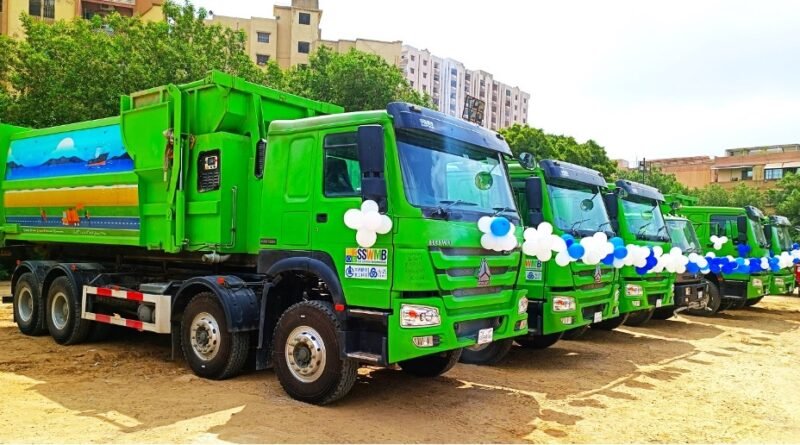
Sindh PAC Flags Legal Vacuum in Solid Waste Board, Orders Formation of Divisional Boards
KARACHI: The Public Accounts Committee (PAC) of the Sindh Assembly on Thursday highlighted a legal vacuum in the Sindh Solid Waste Management Board (SSWMB), observing that the institution had been operating without its legally mandated divisional boards and rules since 2021, with executive authority concentrated in the hands of its managing director.
Under the Sindh Solid Waste Management Board (Amendment) Act, 2021, separate boards are required at the divisional headquarters of Karachi, Hyderabad, Mirpurkhas, Sukkur, Shaheed Benazirabad and Larkana. The respective mayors of metropolitan or municipal corporations are to serve as chairpersons, while divisional commissioners are to act as vice-chairpersons, with the objective of devolving authority to the local level.
Chairing a meeting at the Sindh Assembly to examine audit paras relating to the SSWMB Karachi for 2023 and 2024, PAC Chairman Nisar Ahmed Khuhro directed the Local Government Department to constitute the divisional boards and frame the necessary rules in accordance with the provincial cabinet’s decision.
“The amended Act was passed in 2021 to establish boards under mayors. Four years have passed, yet neither the boards have been formed nor the rules framed. Under which law, then, is a single managing director running the institution?” he questioned.
Committee member Qasim Soomro said the purpose of the amendment was to transfer powers to the lower tier of government and questioned whether the failure to establish the boards was intended to prevent devolution.
SSWMB Managing Director Fawad Soomro maintained that the board constituted under the original 2014 Act continued to function. He said the provincial cabinet and the steering committee had communicated with the Local Government Department, adding that the managing director could exercise executive powers.
The PAC, however, directed the authorities to establish divisional boards in all six divisions in line with the cabinet’s decision and formulate the relevant rules.
The committee also raised serious concerns over the failure to generate revenue through waste recycling and the absence of arrangements to produce electricity from garbage. The audit department pointed out that the public was being deprived of the potential benefit of low-cost electricity from waste.
Responding to the PAC chairman, the SSWMB managing director said the institution had an annual budget of Rs28 billion, of which Rs24 billion was spent on garbage collection and transportation in Karachi alone. He said between 10,000 and 12,000 tonnes of waste were lifted from the city every day.
Khuhro questioned how the enormous quantity of collected waste was being utilised and sought district-wise details of garbage collection. He also questioned the institution’s performance, remarking that if it could not generate electricity from waste, its core responsibilities needed to be examined.
Fawad Soomro informed the committee that an agreement had been reached with a UK-based company to establish recycling units at garbage collection points in Karachi and Hyderabad. He also mentioned an arrangement with the Defence Housing Authority (DHA) for recycling waste.
He said contracts for garbage collection in Karachi had been awarded to three Chinese companies and one Turkish company.
The PAC chairman expressed concern over frequent complaints from different parts of Karachi about garbage not being lifted. He questioned who was responsible for addressing these complaints and ensuring that contractors fulfilled their obligations.
The committee directed the SSWMB to submit a comprehensive district-wise breakdown of waste collected, expenditure incurred and revenue generated.
Committee member Taha Ahmed said garbage remained piled up along roads in Orangi Town, New Karachi, Nazimabad and other neighbourhoods, with residents facing persistent sanitation problems. He also alleged that many SSWMB employees were drawing salaries without attending their duties.
The SSWMB managing director told the committee that a steering committee chaired by the provincial local government minister had been established to oversee the institution and that the board reported to it.
He added that another committee comprising the provincial ministers for planning and development and labour had been formed to make recommendations regarding the establishment of divisional boards.
The PAC’s intervention has brought renewed attention to the governance, accountability and operational performance of the SSWMB, particularly the implementation of the legal framework intended to strengthen local government oversight and improve waste management services across Sindh.