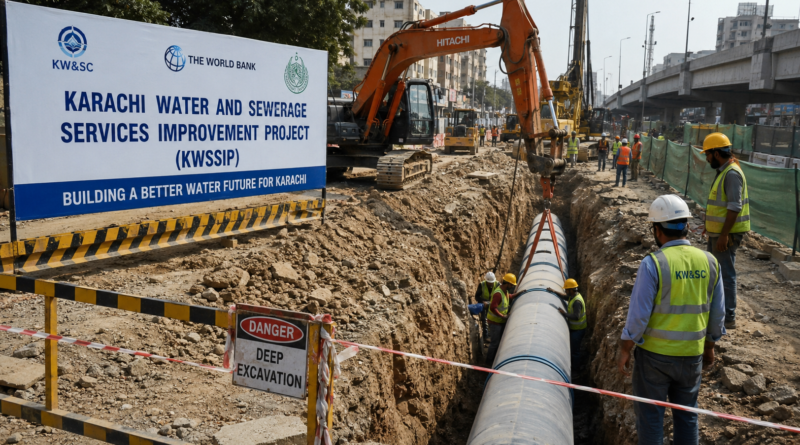
World Bank Raises Red Flags Over Karachi Water Project Delays and Safeguard Violations
KWSSIP-1 and KWSSIP-2 Face Implementation Challenges; Major Risks Identified for K-IV Augmentation and Institutional Reforms
KARACHI – KWSSIP-1 and KWSSIP-2 Face Implementation Challenges; Major Risks Identified for K-IV Augmentation and Institutional Reforms
Karachi: The World Bank has expressed serious concern over the implementation of the Karachi Water and Sewerage Services Improvement Project (KWSSIP-1 and KWSSIP-2), warning that procurement delays, weak project management, unresolved compensation issues, environmental and social safeguard violations, and slow institutional reforms could undermine the success of Karachi’s flagship water sector programme.
In a formal communication to senior officials of the Karachi Water and Sewerage Corporation (KW&SC), the World Bank highlighted significant implementation risks affecting both projects, particularly the K-IV Augmentation Project, and called for urgent corrective measures.
According to the review, KWSSIP-1, which is due to close on 30 June 2026, still has several incomplete activities, including water metering, interventions in informal settlements, and unresolved compensation payments to Project Affected Persons (PAPs). The Bank stressed that all compensation and resettlement obligations must be completed before the project can officially close.
The assessment of KWSSIP-2 raised even greater concerns. Although approved around sixteen months ago and scheduled to continue until December 2030, the project has disbursed only US$3.16 million, representing approximately 1% of the total financing, reflecting substantial implementation delays.
The World Bank identified major procurement bottlenecks involving the K-IV Augmentation Main Works, project management consultancy, design review and supervision consultancy, and Geographic Information System (GIS) activities. It also warned that the supervision consultancy for the K-IV project may need to be re-tendered due to concerns regarding consultant performance.
The review further found that construction on parts of the K-IV Augmentation Common Corridor commenced before compensation had been paid to affected communities, contrary to the project’s Environmental and Social Commitment Plan (ESCP). The Bank described this as a serious safeguard compliance issue and announced that international resettlement experts would be deployed to reassess the project’s resettlement strategy.
Additional concerns include inadequate environmental and social staffing, delays in independent monitoring, incomplete grievance redress mechanisms, outstanding compliance issues related to associated facilities, and unresolved technical matters involving pipeline quality, protective coatings, and construction standards.
The World Bank also highlighted governance and institutional weaknesses within KW&SC, noting that the corporation has yet to establish a functional monitoring and evaluation system despite previous commitments. Institutional reform activities intended to strengthen operational efficiency and financial sustainability have also seen little progress.
The Bank cautioned that transferring unfinished activities from KWSSIP-1 into KWSSIP-2 could divert resources from originally planned investments and jeopardize the achievement of the project’s development objectives.
To address these concerns, the World Bank has issued a comprehensive action plan with deadlines extending from June to August 2026, requiring accelerated procurement, completion of compensation payments, full compliance with environmental and social safeguards, operationalization of monitoring systems, strengthening of institutional capacity, and implementation of governance reforms.
The Bank warned that the coming months will be critical for determining whether Karachi’s flagship water sector investment programme can recover lost time and deliver the intended improvements in water supply, infrastructure, governance, and public service delivery.